April 3rd, 12pm EST
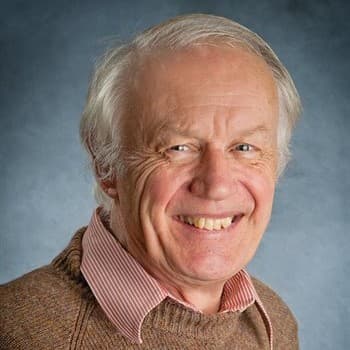
Dr. Leggett, a Nobel laureate in physics, is celebrated for his seminal contributions to the understanding of quantum liquids and superconductors, profoundly influencing the field of condensed matter physics.
Question of the Day
“If superconducting currents can persist longer than the age of the universe, what does that reveal about the boundary between quantum and classical worlds?”
Insight: Leggett shows that quantum effects are not confined to the subatomic scale. Cooper pairs of electrons behave as a single quantum entity at macroscopic scales, producing effects visible to the naked eye. This challenges the common assumption that quantum mechanics only matters at tiny scales.
Talk Highlights: Quantum Liquids
Nobel laureate Dr. Leggett explains quantum liquids -- systems exhibiting macroscopic quantum behavior when three conditions are met: low temperature, quantum mechanics, and liquidity. He shows how indistinguishable bosonic particles undergo Bose-Einstein condensation, and connects this to superconductivity via Cooper pairs, whose persistence has been measured to exceed many times the estimated age of the universe.
Key Takeaways
- Three precise ingredients are needed for a quantum liquid: low temperature for order, quantum mechanics for wavelike behavior, and the ability of particles to change places. Solids satisfy the first two but not the third.
- The indistinguishability of particles only matters when they can exchange positions -- in a solid, atoms are tagged by their lattice positions, but in a liquid, swapping creates fundamental quantum ambiguity.
- Superconductivity arises because Cooper pairs of electrons behave as bosons. BCS theory shows they must automatically undergo Bose condensation, forcing all pairs to move identically -- sustaining current indefinitely.
Notable Quotes
“Bosons are extremely gregarious, and under certain conditions they like to have a macroscopic number of particles in a single state. That is Bose-Einstein condensation, and it is basically the root of most properties of quantum liquids.”
“The lower limit on the time necessary for the superconducting current to decay turns out to be many times the estimated age of the universe. This really is a very macroscopic phenomenon.”
Biography +
Anthony Leggett
Early Life and Education
Sir Anthony James Leggett (26 March 1938 - 8 March 2026) was a British-American theoretical physicist. Born in Camberwell, London, he first earned a degree in Literae Humaniores (Classics) at Balliol College, Oxford, before switching to physics at Merton College. He completed his DPhil in 1964 under Dirk ter Haar.
Career and Contributions
After postdoctoral work at the University of Illinois and Kyoto University, Leggett spent fifteen years at the University of Sussex (1967-1982) developing foundational theoretical work on superfluidity. In 1982 he was appointed MacArthur Chair at the University of Illinois Urbana-Champaign. His most celebrated contribution was his theoretical explanation of superfluid helium-3. He also developed the Caldeira-Leggett model of quantum dissipation and the Leggett-Garg inequality.
Awards and Honors
- 1975: Maxwell Medal
- 1980: Elected Fellow of the Royal Society
- 1992: Dirac Medal
- 2003: Nobel Prize in Physics for pioneering contributions to the theory of superconductors and superfluids
- 2004: Appointed Knight Commander of the Order of the British Empire
Career Timeline +
Career Timeline
- 1938: Born in Camberwell, London
- 1960s: Degrees in Classics and Physics from Oxford
- 1964: DPhil from Oxford
- 1964-1965: Postdoctoral Fellow at UIUC
- 1965-1966: Visiting scientist at Kyoto University
- 1967-1982: Faculty at the University of Sussex
- 1975: Maxwell Medal
- 1980: Elected Fellow of the Royal Society
- 1982: Appointed MacArthur Chair at UIUC
- 1992: Dirac Medal
- 2003: Nobel Prize in Physics
- 2004: Appointed KBE
- 2026: Passed away in Urbana, Illinois
Content produced by Turing Minds. Usage guidelines.