November 1st, 12pm EST
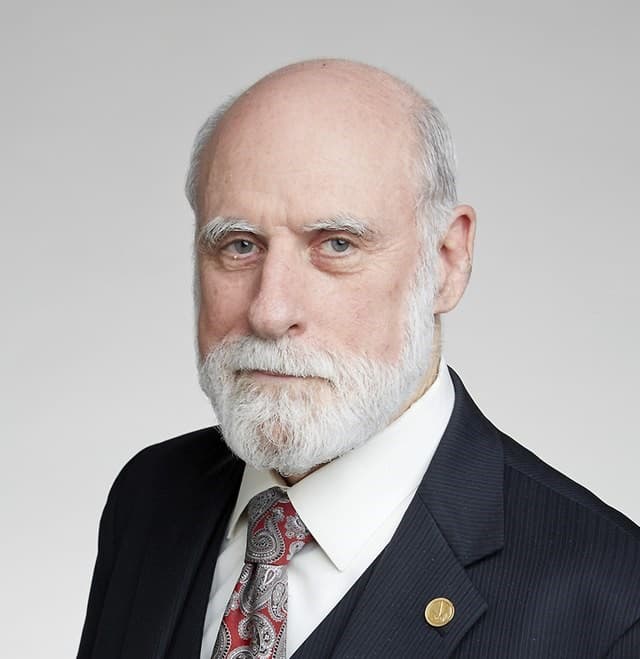
Dr. Vint Cerf, often hailed as one of the 'fathers of the Internet', is a pioneering computer scientist whose work has fundamentally shaped our modern digital world. Awarded the 2004 Turing Award alongside Robert E. Kahn, Dr. Cerf co-designed the TCP/IP protocols and the architecture of the Internet, laying the foundation for global connectivity. His visionary contributions continue to underpin the entire structure of internet communication, enabling the digital revolution that defines our era.
Question of the Day
“Cerf and Kahn chose not to patent TCP/IP to avoid friction for adoption -- when should inventors give up ownership of their work for the greater good?”
Insight: Cerf explains that they could not predict future allies, so eliminating adoption friction was more valuable than any patent revenue. The internet's exponential growth validated this: open standards create ecosystems that dwarf what any single patent holder could capture.
Talk Highlights: Building and Extending the Internet: From TCP/IP to Interplanetary Networking
In this wide-ranging Q&A session, Vint Cerf discussed the evolution of the internet, AI and large language models, IPv6 adoption, and the future of networking. He covered his work on the interplanetary internet, why he and Bob Kahn deliberately made TCP/IP public and unpatented, the need for accountability in online environments, and how neural interfaces will reshape human-computer interaction.
Key Takeaways
- Cerf and Bob Kahn conceptualized 'knowledge robots' (knowbots) in 1988 -- mobile software agents that could move around the internet and take actions on behalf of users -- but the Morris Worm that same year scared everyone away from the concept. Today's AI agents have essentially realized that 1988 vision.
- Google uses machine learning to control data center cooling systems, saving 40% of the power required -- an example of how narrower ML applications deliver enormous value beyond the LLM hype.
- Cerf deliberately delayed introducing cryptography into the early internet despite working with the NSA on packet crypto since 1975, because imposing key management discipline on graduate students would have killed adoption.
- For the interplanetary internet, Cerf's team concluded that all extraterrestrial networks should use IPv6 so that networks on different planets and spacecraft will have non-conflicting address assignments.
Notable Quotes
“Computers are artificial idiots, basically -- which is what AI stands for, in case you didn't know that.”
“We said, we don't know who our allies are going to be 25 years from now, so the best thing to do is just release this publicly and not patent it, in order to avoid any friction for adoption of the technology.”
“If I'd been smart, I would have assigned myself a slash-eight, which today would be worth approximately 800 million dollars, in which case I would be addressing you from a private island somewhere in the Pacific Ocean.”
Biography +
Vint Cerf: Father of the Internet
Early Life and Education
Vinton G. Cerf, widely known as one of the "Fathers of the Internet," was born on June 23, 1943. He holds a Bachelor of Science degree in Mathematics from Stanford University and Master of Science and Ph.D. degrees in Computer Science from UCLA.
Career Milestones
DARPA (1976-1982)
During his tenure with the U.S. Department of Defense's Advanced Research Projects Agency (DARPA) from 1976 to 1982, Cerf played a key role in leading the development of Internet and Internet-related packet data transport and security technologies.
MCI (1982-1986, 1994-2005)
As vice president of MCI Digital Information Services from 1982 to 1986, Cerf led the engineering of MCI Mail, the first commercial email service to be connected to the Internet. From 1994 to 2005, he served as the senior vice president of Technology Strategy and later as MCI's senior vice president of Architecture and Technology.
Corporation for National Research Initiatives (1986-1994)
Before rejoining MCI in 1994, Cerf was vice president of the Corporation for National Research Initiatives (CNRI), where he worked on information infrastructure and digital libraries.
Google (2005-Present)
Since October 2005, Cerf has served as vice president and chief Internet evangelist for Google, contributing to global policy development and the continued standardization and spread of the Internet.
Key Contributions and Achievements
TCP/IP Protocols
Cerf is the co-designer of the TCP/IP protocols and the architecture of the Internet. This groundbreaking work laid the foundation for the modern Internet.
Awards and Honors
- U.S. National Medal of Technology (1997) - Awarded by President Clinton source.
- ACM Turing Award (2004) - Known as the "Nobel Prize of Computer Science" source.
- Presidential Medal of Freedom (2005) - The highest civilian award in the United States, awarded by President George W. Bush source.
- Japan Prize (2008) - Awarded for his work on the Internet protocols.
- Queen Elizabeth Prize in Engineering (2013).
- Franklin Medal (2018) - Awarded for his contributions to the Internet.
- IEEE Medal of Honor (2023).
- Marconi Society Lifetime Achievement Award (2023).
Honors and Memberships
- Officer of the French Legion d'Honneur (2014).
- Foreign Member of the British Royal Society (2016).
- Fellow of the IEEE, ACM, American Association for the Advancement of Science, American Academy of Arts and Sciences, International Engineering Consortium, Computer History Museum, Annenberg Center for Communications at USC, Swedish Royal Academy of Engineering, American Philosophical Society, Hasso Plattner Institute.
- Member of the US National Academy of Engineering and US National Academy of Science.
Advisory Roles
Cerf serves as an advisor to many US Government agencies including the National Science Foundation, NASA, and the US Departments of Defense, Energy, and Commerce. He was appointed by President Obama to serve a six-year term on the National Science Board starting in May 2012.
Leadership in Professional Organizations
- President of the Association for Computing Machinery (ACM) (2012-2014).
- Chairman of the Internet Corporation for Assigned Names and Numbers (ICANN) (2000-2007).
- Founding President of the Internet Society (1992-1995).
Personal Life
Cerf and his wife, Sigrid, were married in 1966 and have two sons, David and Bennett. His personal interests include fine wine, gourmet cooking, and science fiction.
Notable Appearances
Cerf has served as a technical advisor to production for "Gene Roddenberry's Earth: The Final Conflict" and made a special guest appearance on the program in May 1998. He has appeared on television programs such as NextWave with Leonard Nimoy and co-hosted World Business Review with Alexander Haig and Caspar Weinberger. In July 2014, he appeared on the Colbert Report television show.
For more detailed information on Vint Cerf's life and achievements, you can visit his official biography and Google profile.
Career Timeline +
Career Timeline
- 1965: Graduated from Stanford University with a B.S. in Mathematics
- 1972: Earned Ph.D. in Computer Science from UCLA
- 1973: Began work on TCP/IP protocols with Bob Kahn
- 1976-1982: Worked at DARPA, overseeing the development of Internet and Internet-related data packet and security technologies
- 1982-1986: Vice president of MCI Digital Information Services
- 1986-1994: Vice president of the Corporation for National Research Initiatives (CNRI)
- 1992-1995: Served as the founding president of the Internet Society
- 1994-2005: Returned to MCI as senior vice president of Technology Strategy
- 1997: Awarded the U.S. National Medal of Technology source
- 2000-2007: Served as chairman of ICANN
- 2004: Awarded the ACM Turing Award source
- 2005: Awarded the Presidential Medal of Freedom source
- 2005-Present: Joined Google as Vice President and Chief Internet Evangelist
- 2008: Received the Japan Prize
- 2012-2014: Served as President of the Association for Computing Machinery (ACM)
- 2013: Awarded the Queen Elizabeth Prize in Engineering
- 2014: Appointed as Officer of the French Legion d'Honneur
- 2016: Elected as a Foreign Member of the British Royal Society
- 2018: Awarded the Franklin Medal
- 2023: Received the IEEE Medal of Honor and the Marconi Society Lifetime Achievement Award
Content produced by Turing Minds. Usage guidelines.